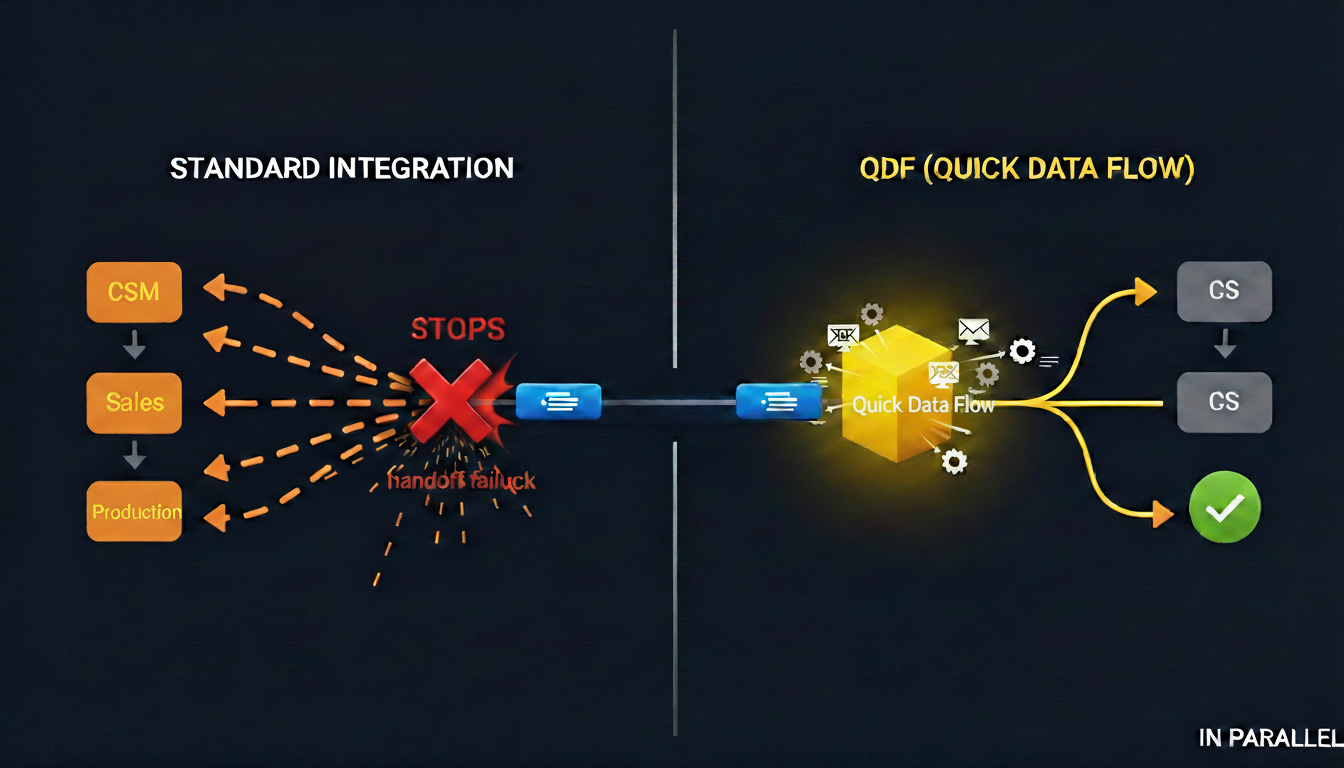
Integration moves data between platforms. QDF moves operations between teams — encoding your SOPs, enforcing ownership, and making handoffs work the way your business actually requires.
You’ve done the work. The APIs are connected. Salesforce talks to your CS platform. Your CS platform talks to NetSuite. The data moves. So why do handoffs still fail?
Data Moves. Context Doesn't.
Sales closes a deal. The record syncs to CS. But the onboarding team doesn’t have the deployment plan, the stakeholder map, or the specific pricing exceptions Sales negotiated. The data arrived. The operation didn’t.
Nobody Owns the Next Action
Your integration moved the record. It doesn’t know who’s responsible for what happens next. CS waits for Ops. Ops waits for Sales. Three days pass before someone manually follows up.
Your SOPs Aren't Encoded Anywhere
“When a deal closes in Q4, expansion conversations wait 90 days.” Your team knows this. Your systems don’t. They trigger the upsell playbook immediately — creating noise, not revenue.
This is the gap QDF was built to solve.Not more connectivity. Operational flows that understand how your business works.
QDF vs Standard Integration
What Makes QDF Different
Standard Integration
QDF (Quick Data Flow)
Moves data based on field changes
Moves operations based on business logic and SOPs
Triggers when data updates
Triggers when business rules require action
No ownership enforcement
Every QDF knows who's responsible for the next action
Handles standard cases only
Built-in exception handling based on your edge cases
Breaks when platforms update
Maintained and evolved as your systems change
One-time build, then abandoned
Governed infrastructure — we don't build and abandon
How QDF Works
Four Layers That Standard Integration Doesn't Have
1
Business Logic Layer
Encodes your SOPs, exception rules, and operational requirements — not just “when field X changes, do Y.”
2
Ownership Enforcement
Every handoff knows who’s responsible. QDF assigns, tracks, and escalates when actions aren’t taken.
3
Context Propagation
Data moves with the context that makes it actionable — not just the record, but what to do with it.
4
Continuous Governance
Maintained as your platforms update, your team evolves, and your business changes. Not built once and forgotten.
Real Applications
Where QDF Makes the Difference
SaaS Company
Expansion Revenue Invisible to Sales
Problem
Product usage analytics showed $3.2M in expansion signals. Sales CRM showed zero. The data existed — Sales never saw it because no system created tasks from usage triggers.
QDF Solution
Built QDF that monitors analytics, applies scoring logic, creates CRM tasks with full context (which features, usage patterns, recommended approach), and assigns to account owner — all automated.
Result: $2.1M in expansion revenue captured in first 6 months. Zero manual monitoring required.
Manufacturing
Sales Quoting Capacity Operations Doesn't Have
Problem
Sales quoted delivery dates based on what CRM allowed. ERP had real-time capacity constraints Sales couldn’t see. 40% of quotes required renegotiation after Ops review.
QDF Solution
QDF connects CRM quote stage to ERP capacity in real-time. When Sales builds quote, QDF checks actual production capacity, material availability, and delivery windows before quote is sent.
Result: Quote accuracy increased to 94%. Sales cycle shortened by 28% (no renegotiation delays).
Franchise Network
HQ and Franchisees Operating on Different Data
Problem
250 franchise locations reporting to HQ via manual CSV uploads. Data was 7-14 days old by the time HQ saw it. Compliance issues, inventory mismatches, missed trends.
QDF Solution
Built bidirectional QDF: franchisee POS systems report to HQ CDHS in real-time, HQ policy updates flow back to franchisees instantly. Automated compliance checks flag issues before they compound.
Result: Real-time visibility across network. 87% reduction in compliance violations. Inventory optimization saved $1.8M annually.
Professional Services
Delivery Teams Starting Projects Blind
Problem
Sales closed deals. Delivery teams received project start notification but no context — no scope details, client expectations, pricing structure, or stakeholder map. First week of every project was spent gathering information Sales already had.
QDF Solution
QDF packages all deal context at close and delivers it to project management system with team assignments, timeline, and SOW automatically attached. Delivery team starts with everything Sales knew.
Result: Project kickoff time reduced from 5 days to same-day. Client satisfaction scores increased 31% (faster, smoother starts).
Average annual revenue recovered per client from operational gaps QDF closed
$0M
Reduction in manual data reconciliation and context-gathering work
0%
QDFs deployed per client on average — every handoff encoded, governed, maintained
0+
Let's Find Your Gaps
See Where QDF Fits in Your System
Most companies we work with have 3-7 handoffs where operations break — usually between Sales and CS, between Marketing and Sales, or between Operations and Finance. A 15-minute diagnostic shows you exactly where yours are.
We'll map how your revenue actually flows
Show you where handoffs fail and why
Identify which gaps QDF solves vs. what needs CDHS or both
Prioritize based on revenue impact and implementation speed
No pitch. No pressure. Just clarity on what’s breaking and how to fix it.
Book Your Diagnostic
Your Operations Shouldn't Break
Every Time a System Updates
QDF is maintained infrastructure — not a one-time build. As your platforms change, your QDFs evolve. As your business grows, we add new flows. This is governed RevOps, not project work.