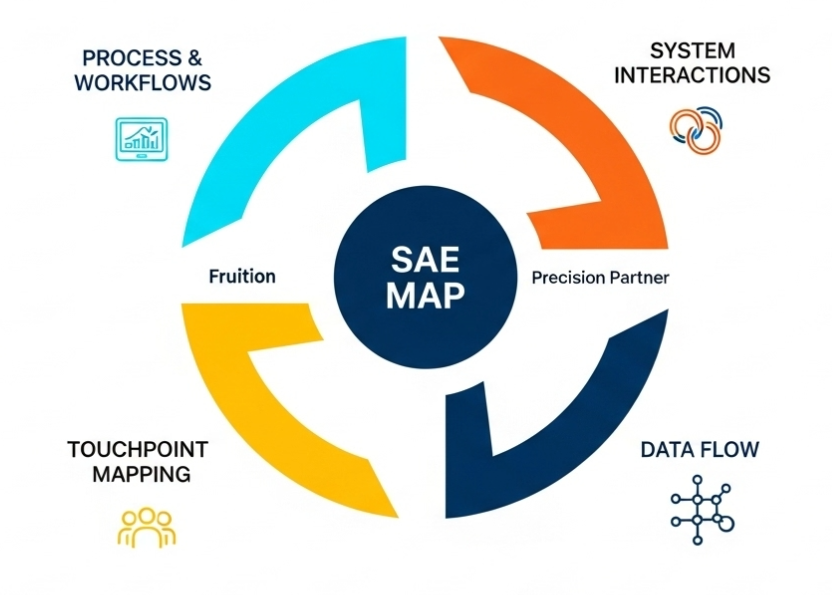
The System Automation Engagement (SAE) Map is not an add-on and not a consulting exercise. It is the blueprint that makes implementation possible without rework, delays, or hidden assumptions.
Departments involved means the number of distinct business functions participating in requirements and validation for the blueprint, such as Sales, Marketing, Operations, Finance, Support, Engineering, or Production.
Up to 2this is for testing only
Up to 3
Up to 6
Systems analyzed
Systems analyzed means the software platforms in scope for this blueprint, such as HubSpot, NetSuite, Monday, CIN7, RingCentral, Slack, Snowflake, or other tools where data/events originate or are consumed.
Up to 2
Up to 4
Up to 8
Business objects identified
Business objects identified means the business records that must be understood for architecture, such as Deal, Ticket, Company, Contact, Order, Line Item, Invoice, Asset, Serial Number, Project, Shipment, or Case. This is identification and responsibility mapping, not full field mapping.
Up to 3
Up to 6
Up to 15
Triggers identified
Triggers identified means the key events that start automation at a conceptual level, such as Call Ended, Deal Stage Changed, Ticket Closed, Order Approved, Shipment Created, Payment Received. The SAE identifies what triggers matter; detailed trigger payload rules are handled in the QDF/CDHS build stage.
Up to 3
Up to 5
Up to 20
Outcomes identified
Outcomes identified means the intended business results across systems, such as “Create a ticket,” “Update deal stage,” “Route a task to a team,” “Log an event,” “Sync a status,” “Notify owners,” “Generate a record,”or “Write to analytics.” These are defined as outcomes, not implemented logic.
Up to 3
Up to 7
Up to 15
Cross-team dependencies mapped
Cross-team dependencies mapped means the number of handoffs where one team’s action or system state becomes another team’s input, such as Sales-to-Ops, Ops-to-Finance, Support-to-Engineering. This is the core complexity driver in multi-department environments.
Up to 3
Up to 8
Up to 20
QDF candidates identified
QDF candidates identified means how many Quick Data Flows are likely needed based on your triggers, outcomes, and cross-system paths. These are candidates and priorities, not commitments to build all of them.
1–2
2–4
4–8
QDF sequencing & build order
QDF sequencing & build order means the SAE outputs a recommended sequence that reduces risk, such as “start with the highest-signal event,” “build foundational data contracts first,” or “stabilize ownership and routing before adding enrichment.”
No
Basic
In Details
CDHS fit assessment
CDHS fit assessment means the SAE explicitly answers whether a CDHS layer is needed for consistency and scaling, whether it’s optional, or whether a direct system-to-system QDF is sufficient.
No
Basic
In Details
Delivery roadmap output
Delivery roadmap output means the number of implementation phases recommended, typically grouping QDFs by dependency and risk, such as Phase 1 foundation flows, Phase 2 cross-department routing, Phase 3 normalization/analytics, Phase 4 scale and governance.
1 phase
2–3 phases
4–6 phases
Final deliverable
Final deliverable describes what you receive at the end of SAE.“SAE Map + Overview Doc” is a concise blueprint plus an executive-friendly summary. “Execution Plan” adds more sequencing detail and responsibility breakdown. “Full Orchestration Blueprint” is the deeper architectural plan for multi-department, multi-system operations.
SAE Map + Overview Doc
SAE Map + Execution Plan
Full Orchestration Blueprint
SAE Map Pricing
Architecture comes first, then we build
Every Data Flow (QDF), Integration, automation, SOP/Workflow and Data Centralization (CDHS) starts with systems blueprint of your system SAE Map.
"We just need to connect between those two systems."
"We just need to see the data in the right place."
You’ve tried that. Maybe multiple times.
And now:
Sales still can't see which accounts are up for renewal
Someone manually exports data every Monday morning
Marketing and Finance are looking at different numbers
The systems are connected — but the data is still invisible
The problem isn't the connection.
It's that nobody mapped what's actually supposed to happen.
The SAE Map answers the questions integrations can't:
Which systems own which data?
Where do handoffs actually break between departments?
What triggers revenue to become invisible?
Which automations should fire first?
What needs to be built vs. what can be configured?
That's why every engagement starts here.
Not because we want to sell architecture.
Because building without it creates expensive rework.
QDFs are designed around how your business actually operates, not platform limitations. If you want to ensure this fits how your SOP and processes really work, we’re here to align it with you.
Every Quick Data Flow (QDF), Integration, automation, SOP/Workflow and Data Centralization (CDHS) starts with systems blueprint of your system SAE (System Automation Engagements) Map.
This is the architecture phase of the project, where we define scope, dependencies, and sequencing so the build is accurate, predictable, and aligned across teams.
The SAE Map is not an add-on and not a consulting exercise. It is the blueprint that makes implementation possible without rework, delays, or hidden assumptions.
What Our Clients Say
Erick Rodrigo,
CEO, AMZ AllStars, Philippines
Kiefer was excellent to work with —a true professional and subject-matter expert in HubSpot CRM implementation. His deep knowledge, attention to detail, and proactive approach made the entire process seamless. Highly recommended for anyone looking for a top-tier CRM specialist. Great guy, fantastic experience!”
Shiv Gupta,
CTO & Co-Founder, GigaEnergy, USA
Kiefer and his team are professionals! There are many “software integrators” on HubSpot, but if you are a serious company looking to get critically thought-out work done fast, then Kiefer and his team, Fruition Rev Ops, are the people you should talk to. Kiefer and his team will continue to play a big role in our company as we continue to build out our systems.
Eran Shalev,
VP of Marketing Product, VideoFlow
A rare combination of thinking out of the box, a methodical approach, as well as learning the market at record speed, was key to fast business growth.
See Video Testimonial Here.
Chris Curran,
COO, CreativeForce, UK
Kiefer was incredibly to work with. Both extremely intelligent and hardworking. Understands his craft inside out like no one I had experienced to date. Create an amazing and industry defining system for my team and I to use everyday on Hubspot. Also a great guy. Highly recommend.
David Aronchick,
CEO, Expanso, USA
Just terrific! Able to pick up the job super quickly, ran with it in ways we didn’t know what we needed, and delivered high quality and ahead of time. Would absolutely rehire.”
Lawrence Stuart
Head Of Sales, creenz
Their professionalism and efficiency are huge assets in making informed decisions throughout all growth aspects,
and their work consistently exceeds expectations.
See Video Testimonial Here.
Gal Zacharia
Head of Customer Success, Cincopa
Fruition built a very efficient sales automation campaign funnel, which enabled us to generate a great funnel of high-quality leads, create and implement several successful campaigns,and take our marketing efforts to new heights.
Keely Chapman,
Head of Marketing, Parkerlane, Australia
Highly recommend! I’m so glad I had the opportunity to meet and collaborate with the team. Working together has been quick, easy, and seamless. I’m looking forward to our next project together!”
Itai Ard
Founder & CEO, WinkApp
His vast experience and the ability to see situations and possibilities from a bird’s-eye view and also dive into the small details are what make him unique in the field.
Lilach Dekel
Marketing Manager, Vimmi Communication
His vast experience and the ability of the team @ Fruition to build from scratch a very efficient funnel, created and implemented several successful campaigns, and took our marketing efforts to new heights. Their contribution to our sales and marketing departments was instrumental to the success.
Valin Tzure
Head of Business Development, Sleeprate
The results were compelling: we saw a boost in engagement with new Marketing Qualified Leads (MQLs) by over 30%, our subscription engagements more than doubled, and our website’s bounce rate decreased by a whopping 60%.
Mayya Bozhilova,
Head of Operation, 3SpaceLab, USA
Extremely knowledgeable about HubSpot and Automation. He supported us through the selection, implementation, and onboarding process with ease. He’s definitely a subject matter expert, and working with him has been smooth and collaborative. I would absolutely recommend him.
Jonathan Sacks,
Marketing Manager, Wendelboe Digital, USA
If you are looking for a HubSpot and implementation expert, Kiefer and his team are your guy! Although we did not need any in-depth work done in our account, he was able to answer all of our questions for issues we could not solve. He also built reports that were easy to understand. Thanks again!”
How implementation works at Fruition
Before we build any automation, we align on how your systems, teams, and events are supposed to work together. The SAE Map establishes that alignment. Once the architecture is clear, we move into QDF and CDHS implementation with a concrete plan, clear boundaries, and a proposal based on facts instead of estimates.
This approach protects both sides. It prevents building the wrong flows, over-engineering, or discovering critical dependencies mid-implementation.
Important notes before you choose a plan
The SAE Map defines structure and direction, not implementation details.
Detailed field mappings, trigger payloads, transformation logic, and system-level configurations are intentionally handled during the QDF and CDHS build phases, where they can be validated and implemented correctly.
Each plan is sized by the number of departments, systems, objects, and dependencies involved . If your scope exceeds the plan limits, we move to an Enterprise SAE so the architecture reflects your real operational complexity.
The SAE Map output is reusable. Even if you decide to pause after this phase, you leave with a clear architectural blueprint that can be used internally or as the basis for future implementation.
Why is SAE required before implementation?
Cross-system automation fails most often because architecture decisions are made implicitly during build. SAE makes those decisions explicit upfront. It ensures that QDFs are sequenced correctly, ownership is clear, and system behavior is consistent as your operation scales.
In practice, SAE shortens implementation timelines, improves proposal accuracy, and prevents costly redesigns later.
What happens after SAE
Once the SAE Map is complete, we deliver a QDF and/or CDHS proposal based directly on the approved architecture. You can proceed immediately, adjust priorities, or phase the work — without revisiting fundamentals.
Enterprise SAE
If your environment exceeds the plan limits above, or if multiple business units, regions, or custom systems are involved, SAE is scoped as a fully customized Enterprise engagement.
SAE Map Frequently Asked Questions
Do we have to do an SAE Map before you build a QDF?
In most cases, yes. The SAE Map is how we prevent scope confusion and rework. If your request is truly narrow and well-defined, we can sometimes move directly to a small QDF build, but for cross-team or multi-system work, SAE is the gate that makes the build phase predictable.
Is the SAE Map a technical document or an executive document?
It is both. The map and structure are written so technical teams can build from it, and the Overview/Plan sections are written so leadership can approve it without needing to interpret technical detail.
Does SAE include detailed field mapping for every attribute?
No. SAE identifies the objects and the key attributes that drive decisions. Detailed field mapping, transformation rules, and edge-case logic are part of the QDF/CDHS build stage, where requirements are validated and implemented.
What do you mean by “Triggers” and “Outcomes” in SAE?
Triggers are the events that start a flow conceptually, and outcomes are the business results that must happen. SAE defines these at the architectural level so the implementation can be quoted accurately.
What happens after the SAE Map is delivered?
You receive a proposal for QDF build (and CDHS if required) that is based on the SAE scope, sequencing, and dependency model. You can approve the proposal, adjust the rollout order, or pause with a complete blueprint in hand.
If we exceed the limits in a plan, do we have to buy the next plan?
Not automatically. If you exceed limits slightly, we can adjust within reason. If the scope is materially larger, we move to Enterprise SAE so the engagement remains accurate and fair.
Can we use SAE even if we’re not sure we want CDHS?
Yes, and that’s one of the best uses of SAE. The CDHS fit assessment exists to prevent over-building. SAE will tell you when a direct QDF is enough and when a hub layer becomes necessary.
How long does the SAE Map take?
It depends on plan size and stakeholder availability. The engagement is designed to be fast, but the biggest driver is how quickly teams can provide access, answers, and validation.
Does SAE reduce the cost of implementation?
It reduces waste and rework. In practice, it shortens cycles, improves accuracy of quoting, and prevents expensive redesigns that happen when automation is built without a shared architecture.
What if we already have diagrams and documentation?
Great. We will use them, but we still validate reality with stakeholders and systems. Most teams have partial documentation; SAE turns it into an implementable blueprint with clear sequencing and ownership.
Ready to build?
QDF pricing is designed to match the coordination your business actually needs. Whether you’re automating a single team’s workflow or orchestrating cross-department operations, each tier gives you the structure and support required to build automation that lasts.
Start with the SAE Map to define your architecture, then implement QDFs in the order that delivers the most value. You control the pace, the scope, and the sequence.