























One Spine. One Brain. One Source of Truth.
Even if you have never heard of a Centralized Data Hub System before, your business is already paying for not having one.
The Infrastructure Behind Real Data Mastering
Governed, Not Just Glued
Operational and Analytical
Extendable by Design
Why Integration Alone Never Gets You to Data Mastering
What CDHS Actually Does to Your Data
1
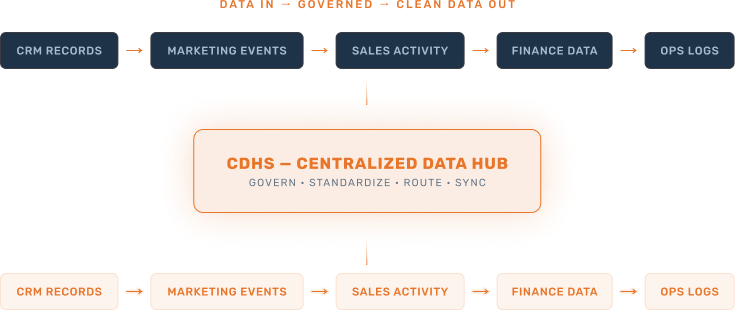
Collects from Every System
CRMs, ERPs, marketing platforms, and spreadsheets all feed into CDHS through a single governed intake. No system gets left out, no record goes missing.
2
Standardizes Every Definition
"Customer," "account," and "client" all mean the same thing everywhere. Duplicates are removed, broken links are fixed, and fields are aligned across every platform. This is the governance layer that makes data mastering sustainable rather than a one-time cleanup.
3
Stores in One Governed Hub
The clean record lives in one authoritative location. Every other platform points back to this source instead of maintaining its own competing version.
4
Routes Based on Your SOPs
CDHS does not force your teams to change how they work. If Sales uses HubSpot and Production uses Monday, both teams continue in their preferred tools while the hub keeps their data synchronized and consistent.
5
Keeps Everything in Sync Automatically
Every time a change happens in one tool, CDHS updates the others in real time. Reconciliation meetings, manual exports, and mismatched dashboards become a thing of the past.
1
Source of Truth
0
Manual Exports
∞
Systems Supported
RT
Real-Time Sync
CDHS Is for Teams That Are Done Fixing Data
Marketing and Demand Gen
Sales and Revenue Leaders
Operations and Delivery
Finance and Executives
AI and Automation Teams
RevOps Architects
Where Most Data Hubs Fall Short
| Capability | Standard Integration Layer | CDHS by Fruition RevOps |
|---|---|---|
| Data governance before automation | ✗ Rarely | ✓ Always |
| Shared record ID across all systems | ✗ No spine | ✓ Built-in |
| Routing based on your SOPs | ✗ Rule-agnostic | ✓ SOP-driven |
| Operational and analytical in one hub | ✗ Usually one or the other | ✓ Both, simultaneously |
| Scales without breaking existing flows | ✗ Brittle | ✓ Modular by design |
| AI-agent ready data foundation | ✗ Needs separate cleanup | ✓ Governed from day one |
| Teams keep their preferred tools | ✗ Often forces migration | ✓ Tool-agnostic |
Common Questions About CDHS
What exactly is a Centralized Data Hub System?
How is CDHS different from tools like Zapier or HubSpot Operations Hub?
Do we have to change the tools our teams already use?
What does the implementation process look like?
Is CDHS related to MDM (Master Data Management)?
Stop Fixing Data. Start Using It.
Synchronize Every Process in One Centralized Data Hub System
You Can’t Work With Broken Data
When everyone works from the same truth, it stops being a guessing game.
When data is clean and connected, every part of the business runs smoother.
Even if you’ve never heard of a centralized data hub system before, your business is already paying for not having one.
Where Most Data Hubs Fail (and CDHS Doesn’t)
Governed > Glued
Most hubs patch connections. CDHS enforces definitions and governance first, so every integration runs clean, consistent, and compliant, even as your stack evolves.
Operational + Analytical
Typical hubs serve one purpose. They either run operations or feed dashboards. CDHS powers both, uniting execution and insight in one centralized data hub system.
Extendable by Design
Other systems collapse when you add new tools. CDHS scales with you. Plug in, expand, and evolve without breaking the flows that already work.
What a Centralized Data Hub System Actually Does

It collects data from every system you use.
CRMs, ERPs, marketing platforms, spreadsheets—CDHS pulls information from all of them. Think of it as a single intake valve for your company’s data.

It cleans and organizes that data.
CDHS standardizes names, formats, and fields so “customer,” “account,” and “client” all mean the same thing everywhere. It removes duplicates, fills gaps, and fixes broken links between systems.

It stores the clean data in one governed location.
This is the hub—the core database where every record lives in its most accurate form. Every other platform points back to this source instead of keeping its own version.

It pushes the right data back out to the right tools.
Once the data is clean, your centralized data hub system sends it where it’s needed, whether that’s CRM, analytics, automation, or finance, so every team always sees up-to-date, identical information.

It keeps the whole system in sync, automatically.
Every time a change happens in one tool, CDHS updates the others in real time. No more manual exports, imports, or mismatched dashboards.
Who is CDHS for?
Ops & RevOps Leaders
Your workflows depend on data that rarely agrees. CDHS creates clean, governed data pipelines that synchronize every process. One reliable centralized data hub supports the growth you’re building toward.
Marketing & Sales
You can’t run great campaigns on dirty data. CDHS eliminates duplicates, unifies lead and account records, and keeps campaign metrics aligned across every tool. The result: consistent targeting, faster follow-ups, and better conversions powered by one shared truth.
Finance & Execs
If the numbers change depending on who you ask, there’s no real visibility. CDHS gives you financial data you can finally trust. Every report, every forecast, every board-ready metric comes from one governed hub.
The Centralized Data Hub System, Explained
Sales
Enters or updates a deal in the crm, and that same information instantly appears in finance, operations, and analytics.
Marketing
Tracks a lead once, and every system recognizes it as the same person—no duplicates, no mismatched fields.
Operations
Can see accurate order and fulfillment data without exporting spreadsheets or waiting for manual updates.