


























Built from your SAE Map, we design workflows that connect systems and trigger the right actions at the right time.
We choose the optimal path—native connectors, APIs, iPaaS (Make, Workato), or N8N—for reliable, scalable data flow.
We onboard your team, document workflows, and ensure everyone knows how the system works.
You need workflows that don’t break when platforms update. We implement Quick Data Flows using your SAE Map as the blueprint—connecting CRM, ERP, operations, and finance so every action flows automatically without custom code that breaks on the next update.
Built from your SAE Map, we design the central hub that connects all systems and establishes your single source of truth.
We establish control and accuracy across every record, ensuring clean, consistent, reliable data everywhere.
We define ownership, validation rules, and automated flow logic to keep your data clean as it scales.
We map your customer journey, identify engagement gaps, and design campaigns that address specific revenue leakage points.
We design coordinated workflows across email, SMS, in-app messaging, and sales triggers for unified engagement.
We build, test, launch, and continuously optimize your campaigns for maximum conversion and engagement.
Selecting the optimal path for seamless, scalable data flow across Departments.
From simple plug-ins to advanced cross-system builds, we tailor each setup to your business logic.
Your new tools integrate smoothly, align with your workflows, and start delivering value from day one.
Visualize your business blueprint. See every system, process, and touchpoint in one place.
Find and fix the invisible cracks draining your time, money, and margins — before they turn into growth barriers.
Centralize scattered data and replace confusion with clarity, ensuring every department works from one truth of data and build your single source of truth (SSOT).
We map how work truly gets done across RevOps, Production, and Operations — turning chaos into structured processes.
Every SOP is built with automation in mind, ensuring systems and people work together. Not against each other.
We don't just document; we drive adoption. Teams learn how to follow, improve, and trust the process, turning SOPs into muscle memory.
Hands-on training sessions tailored to your team's roles, ensuring everyone uses new systems confidently from day one.
Track adoption metrics, identify blockers, and continuously optimize workflows to ensure your team actually uses what you built.
We're Gold Partners with HubSpot, Monday.com, and Segment — meaning we bring certified expertise to every implementation.
We align your go-to-market strategy with your tech stack, designing the operational backbone that connects Marketing, Sales, and CS.
Our consultants analyze your funnel, uncover hidden inefficiencies, and rebuild your operations for precision, speed, and scalability.
From HubSpot and NetSuite to Monday.com and Shipwell, we integrate and orchestrate your tech ecosystem into one coordinated revenue engine.
Two decades transforming disconnected systems into unified revenue engines.
Your questions answered
Answer: Great question! The key differences lie in their focus and stages. The Sales Funnel is centered on converting leads into paying customers, focusing on the sales process. The Marketing Funnel is about the customer’s journey from initial brand interaction to purchase. The RevOps Funnel integrates sales, marketing, and customer success for a unified approach, covering the entire revenue process. Lastly, the Customer Service/Success Funnel ensures customer satisfaction post-purchase and fosters loyalty. In a broader RevOps strategy, these funnels work together to ensure a seamless customer journey, from awareness to advocacy.
Answer: Identifying gaps requires a deep understanding of your customer’s journey. We recommend starting with stakeholder alignment to ensure all teams are on the same page. Then, gather data from all touchpoints to get a comprehensive view. By visualizing this data through journey mapping, you can easily pinpoint areas of friction or drop-offs. Continuous feedback from customers and regular data analysis will further help in identifying gaps and opportunities. Tools like Customer Data Platforms (CDPs) can be invaluable in this process, as they provide a unified view of the customer.
Answer: These three concepts are the backbone of modern operational efficiency. The Customer Data Platform (CDP) centralizes and organizes customer data, creating a unified profile. This data can then inform Process Automation, allowing businesses to automate repetitive tasks and streamline workflows. Integration and Interoperability ensure that different software systems and platforms communicate seamlessly. When these three concepts work together, businesses can deliver a consistent customer experience, optimize workflows, and ensure data accuracy across the board.
Answer: An effective transition between funnels requires clear communication, defined processes, and the right tools. First, it’s essential to have clear criteria for when a lead moves from one stage to the next. For instance, a lead might transition from the Marketing Funnel to the Sales Funnel once they’ve engaged with a specific piece of content or shown buying intent. Using tools like CRM systems can automate this handoff, notifying the Sales team when a lead is ready. Regular meetings between teams can also ensure everyone is aligned. Lastly, feedback loops are crucial. If the Sales team notices trends or issues with the leads they’re receiving, this feedback should be communicated back to Marketing for continuous improvement. The same applies to the handoff between Sales and Customer Success. The key is a collaborative approach, where each team understands their role and the importance of the handoff for overall customer satisfaction and business growth.
Answer: Measuring funnel effectiveness is crucial for continuous improvement. For the Marketing Funnel, key metrics include lead generation rate, lead-to-MQL (Marketing Qualified Lead) conversion rate, and cost per lead. In the Sales Funnel, you’d look at MQL-to-SQL (Sales Qualified Lead) conversion rate, sales cycle length, and close rate. For the RevOps Funnel, which encompasses the entire revenue process, metrics like customer lifetime value (CLTV), customer acquisition cost (CAC), and overall ROI are vital. Lastly, the Customer Service/Success Funnel would focus on customer satisfaction scores, Net Promoter Score (NPS), and customer retention rates. Regularly analyzing these metrics provides insights into where the funnels are performing well and where there’s room for improvement.
Answer: Re-engaging lost prospects or customers requires a proactive approach. First, segment these individuals based on where they dropped off in the journey. For prospects who showed interest but didn’t purchase, targeted email campaigns or special offers can reignite their interest. For existing customers, personalized content based on their past behavior or preferences can be effective. Regular feedback surveys can also provide insights into why they disengaged, allowing businesses to address specific pain points. Additionally, retargeting ads on social media or search platforms can remind them of your offerings. The key is to make them feel valued and show them the benefits of re-engaging with your brand.
Answer: Data privacy is paramount in today’s digital age. When implementing automation tools like CDPs, businesses must prioritize data protection. This starts with being transparent with customers about how their data is used and ensuring opt-in consent. Regular audits of data collection and storage practices are essential. Tools should be compliant with regulations like GDPR, CCPA, or other regional data protection laws. Additionally, businesses should invest in regular training for their teams to stay updated on best practices and ensure that any third-party integrations or tools also adhere to these standards. By prioritizing data privacy, businesses not only comply with regulations but also build trust with their customers.
At Fruition RevOps, we envision a transformative approach to Revenue Operations, emphasizing the unique yet interconnected roles of Marketing, Sales, and Customer Services. Our aim is to bridge these functions, fostering collaboration not just within them but also with other departments in an organization. The ultimate goal? To create a harmonized ecosystem where processes, platforms, and people are synchronized for maximum ROI.
Today, we’re spotlighting a pivotal element of RevOps: the funnels. These aren’t just pathways but powerful tools that, when optimized, can revolutionize business operations, catalyzing unprecedented growth. The potential of well-structured funnels is vast, from streamlining customer journeys to boosting conversions and ensuring sustainable growth.
Whether you’re new to RevOps funnels or looking to refine your approach, today’s insights will equip you with the knowledge to excel. So, let’s embark on this enlightening journey and uncover the magic of funnels in RevOps!
When leads don’t progress or convert as anticipated, it often points to gaps or inefficiencies in the funnel strategy. Today, we’ll delve into the intricacies of funnel utilization within the RevOps framework. But remember, it’s not just about having a funnel; it’s about meticulously guiding each lead through a journey tailored to its potential, ensuring every touchpoint is optimized.
The world of funnels is vast, and choosing the right one is crucial. It’s not a one-size-fits-all approach; it’s about aligning the funnel with your specific objectives, audience, and offerings.
To streamline our understanding of the myriad of funnels and their types, let’s compartmentalize them into four primary categories:
First up, we have the Awareness to Conversion funnels. These are the foundational funnels that ignite the spark in any business. They play a pivotal role in establishing initial connections, be it with potential prospects, new contacts, or even first-time buyers, especially in an ABM (account-based marketing) framework.
Next, we delve into the Engagement and Nurturing Funnels. These are tailored for prospects who might be interested but aren’t quite ready to take the leap. The transition of leads from QL to MQL is a delicate phase, and understanding the journey of our prospects and customers is paramount. This brings me to emphasize the criticality of fostering alignment between Marketing, Sales, and Product teams.
Our third category is the Retargeting Funnel. This is designed for those who’ve shown interest but aren’t yet prepared to advance to the more committed stages like SQL and CQL.
Lastly, we focus on Loyalty and Advocacy. While acquiring new customers is essential, nurturing existing ones and fostering long-term relationships is equally crucial. Often, post-sale opportunities are overlooked, but this is where true customer loyalty and advocacy are cultivated.
In conclusion, I urge you to collaborate with your teams, evaluate your existing funnels, and identify any gaps. Remember, these funnels should work in tandem, each complementing the other, to create a seamless and effective RevOps strategy.
To simplify the process of analyzing your funnels and identifying potential leaks, let’s categorize the funnels based on departmental objectives.
As displayed on the screen, we’ve segmented each department into three primary objectives: The Focus of the Funnel, the Stage it pertains to, and the Goal we aim to achieve with the Funnel.
However, the journey doesn’t end here! We also need to consider the RevOps Funnel. This funnel acts as the bridge, seamlessly connecting the departments and facilitating the transition of contacts or prospects between stages. It’s crucial to highlight that this is often where leads can slip through the cracks, resulting in lost engagement opportunities within the funnel.
Having delved into the intricacies of mapping your funnels to respective departments and stages in the customer journey, we now shift our focus to the second pivotal topic: Understanding and defining your Customer’s journey.
The essence of a successful RevOps strategy lies in truly grasping the nuances of your customer’s journey. By comprehending their path, and juxtaposing it with the funnel mapping we discussed earlier, you can pinpoint areas of potential leakage. This insight is invaluable, as it allows you to fortify those weak spots, ensuring that no client or prospect slips away.
To aid in this endeavor, let’s explore a comprehensive framework to effectively map out your customer’s journey:
Awareness: This is the initial touchpoint where potential customers first become aware of your brand or offerings. What channels are they coming from? What content or campaigns are resonating with them?
Consideration: At this stage, prospects are actively evaluating your solutions. What information are they seeking? How are they comparing you to competitors?
Decision: This is the pivotal moment where prospects decide to become customers. What factors influence their decision? What barriers or objections need to be addressed?
Onboarding: Once a decision is made, how smooth is the transition? Are there clear onboarding processes in place to ensure a positive initial experience?
Engagement: How are customers interacting with your product or service? Are they fully utilizing its features? What feedback loops are in place?
Retention: What strategies are employed to keep customers engaged and loyal? How are you addressing any concerns or challenges they face?
Advocacy: The ultimate goal is to transform satisfied customers into brand advocates. How are you encouraging referrals, testimonials, or case studies?
By meticulously mapping out each of these stages, and overlaying it with your funnel strategy, you’ll be equipped with a holistic view. This perspective not only highlights areas of strength but also reveals opportunities for enhancement, ensuring a seamless and enriching journey for every customer.
With the foundational knowledge of the customer journey framework in place, it’s time to weave together the three pivotal elements: the mapping of your existing funnels, the intricacies of the customer journey, and the identification of potential leaks. This holistic approach ensures a robust RevOps strategy that leaves no stone unturned.
To streamline this integration, let’s break it down into four actionable steps:
Audit & Analysis: Begin by conducting a thorough audit of your existing funnels. Which stages are performing well? Where are the bottlenecks or drop-offs? This analysis provides a clear picture of your current state and sets the stage for optimization.
Overlay with Customer Journey: With the audit insights in hand, overlay this data onto the customer journey framework. This juxtaposition allows you to see how your funnels align with each stage of the journey, revealing gaps or overlaps that need attention.
Identify & Address Leaks: Armed with this comprehensive view, pinpoint areas where prospects or customers might be slipping away. Are there stages in the journey that lack a corresponding funnel? Or perhaps a funnel that doesn’t cater to a specific segment of the journey? Addressing these leaks ensures a seamless flow from one stage to the next.
Iterate & Optimize: RevOps is a dynamic process. Regularly revisit your funnels and customer journey mapping, seeking feedback, analyzing performance metrics, and making necessary adjustments. This iterative approach ensures that your strategy remains agile and responsive to evolving customer needs and business goals.
To truly maximize the potential of your RevOps funnels, it’s essential to have the right platforms in place, and HubSpot stands out as a prime example. As a credited partner with HubSpot, we’ve seen firsthand the comprehensive suite of features it offers.
HubSpot is not just a tool; it’s an ecosystem that understands the nuances of each department individually. Whether it’s Marketing, Sales, or Customer Service, HubSpot has tailored solutions for each. But what truly sets it apart is its ability to allow data to flow seamlessly between departments. This inter-departmental data sharing ensures that every team is equipped with the information they need, fostering better understanding and collaboration.
Moreover, HubSpot’s robust reporting capabilities, as you can see on the screen, allow businesses to visualize every stage of their funnels. It provides clarity on the customer journey, regardless of the source, touchpoint, or strategy, be it PLG, SLG, or ABM. This level of insight is invaluable for businesses aiming to optimize their RevOps strategy.
When it comes to selecting the right platform for your RevOps strategy, it’s crucial to understand that there are multiple concepts and approaches to implementation. Today, I’ll introduce you to three primary concepts that, when implemented correctly, can holistically address your funnel solutions.
CDP (Customer Data Platform):
Integration:
Automation:
In essence, the right platform, combined with these three concepts, can supercharge your RevOps strategy, ensuring that you’re always ahead of the curve and maximizing ROI.
As we draw closer to the conclusion of our session, I’d like to highlight the essential objectives that should guide your approach when you’re in the process of building, refining, or adjusting your RevOps funnels and strategies.
Holistic Viewpoint:
Integration & Interoperability:
Continuous Improvement:
Empowerment & Training:
Feedback Loops:
In essence, building a robust RevOps strategy is not a one-time task. It’s an ongoing journey of understanding, adapting, and optimizing. As you embark on this journey, keep these objectives in mind, and you’ll be well on your way to achieving operational excellence and unparalleled growth.



Embarking on the path to automating your outbound and inbound operations can seem daunting, but with Fruition RevOps by your side, it becomes a navigable endeavor.
Our expertise lies in tailoring and implementing revenue operations strategies that resonate with your unique business needs.
The journey with us begins with a comprehensive evaluation meeting, where we dive deep into understanding your current processes, challenges, and aspirations.
This assessment forms the bedrock of our collaboration, allowing us to design automation solutions that optimize your operations and pave the way for sustainable growth. With Fruition RevOps, you’re not just adopting a tool or a tactic but investing in a partnership geared toward achieving your company’s fullest potential.

Provide you with a complete overview of the type of funnel and how to manage it.
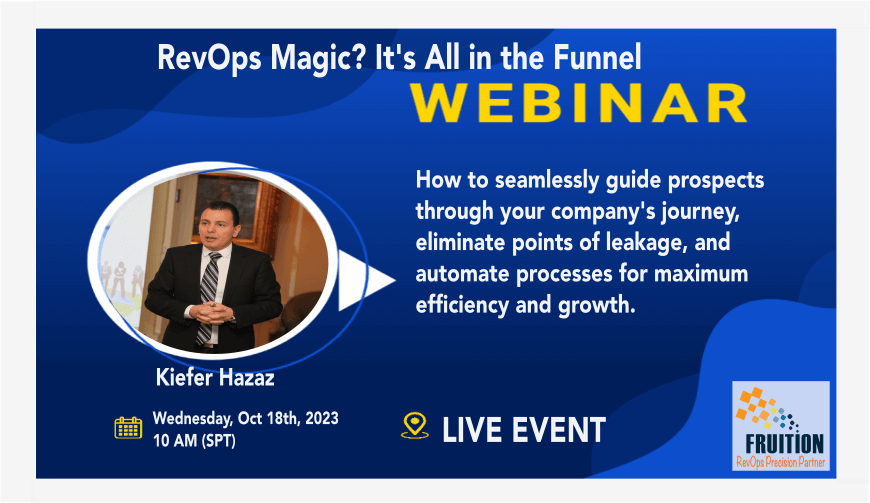
Webinar Topic: Fix the Leak with Streamline Your Revenue Path with RevOps Funnels.
How to seamlessly guide prospects through your company’s journey,
Fill out the form below, and blogs, videos and content will come directly to your inbox.