
























Snowflake Platform Governance Starts Outside the Warehouse
CDHS enforces alignment upstream so Snowflake reflects intentional business reality.

Snowflake Isn’t the Missing Piece It Reveals What’s Missing
Adopting the Snowflake platform is a sign that your organization has reached a point where spreadsheets, departmental databases, and fragmented reporting can no longer support how the business operates or how leadership needs to think.
The goal is to create a centralized, scalable foundation for analytics that executives can trust, teams can build on, and future initiatives like automation and AI can depend on. Snowflake delivers on that promise. It provides performance, visibility, and the ability to see the business in full, often for the first time.
What Snowflake is designed to do is make outcomes observable. It captures what systems produce and makes that data available for analysis, planning, and decision-making at scale.
What it is not designed to do is decide how those outcomes should be produced in the first place.
This distinction matters. Because once everything is visible, inconsistencies that were previously hidden become impossible to ignore. Snowflake does not create those inconsistencies. It simply reveals them with precision and speed.
And that visibility is often the moment you realize the real problem is not analytics maturity, but governance maturity.
The Gap the Snowflake Platform Intentionally Leaves Open
The Snowflake platform is deliberately system-agnostic. It does not enforce business process logic, decide which system is authoritative in a given moment, or resolve timing conflicts between tools. This is not an oversight. It is an intentional architectural choice.
In practice, most organizations do not operate under those conditions.
Sales moves faster than finance. Operations advances while contracts are still being finalized. Statuses change out of sequence. Exceptions are handled manually and reconciled later. Each system behaves rationally within its own domain, but no system is responsible for governing how they behave together.
Snowflake records all of this faithfully. It captures every event, every change, every discrepancy, with accuracy and speed. What it cannot do is arbitrate between them.
That gap becomes visible only once everything is observable. And at the executive level, it creates a familiar paradox: data is centralized, dashboards are populated, and yet alignment still feels fragile.
The Assumptions the Snowflake Platform Relies On
Agreement on Meaning
What does this record actually represent?
Agreement on Timing
When is a status change valid?
Agreement on Authority
Which system gets to decide?
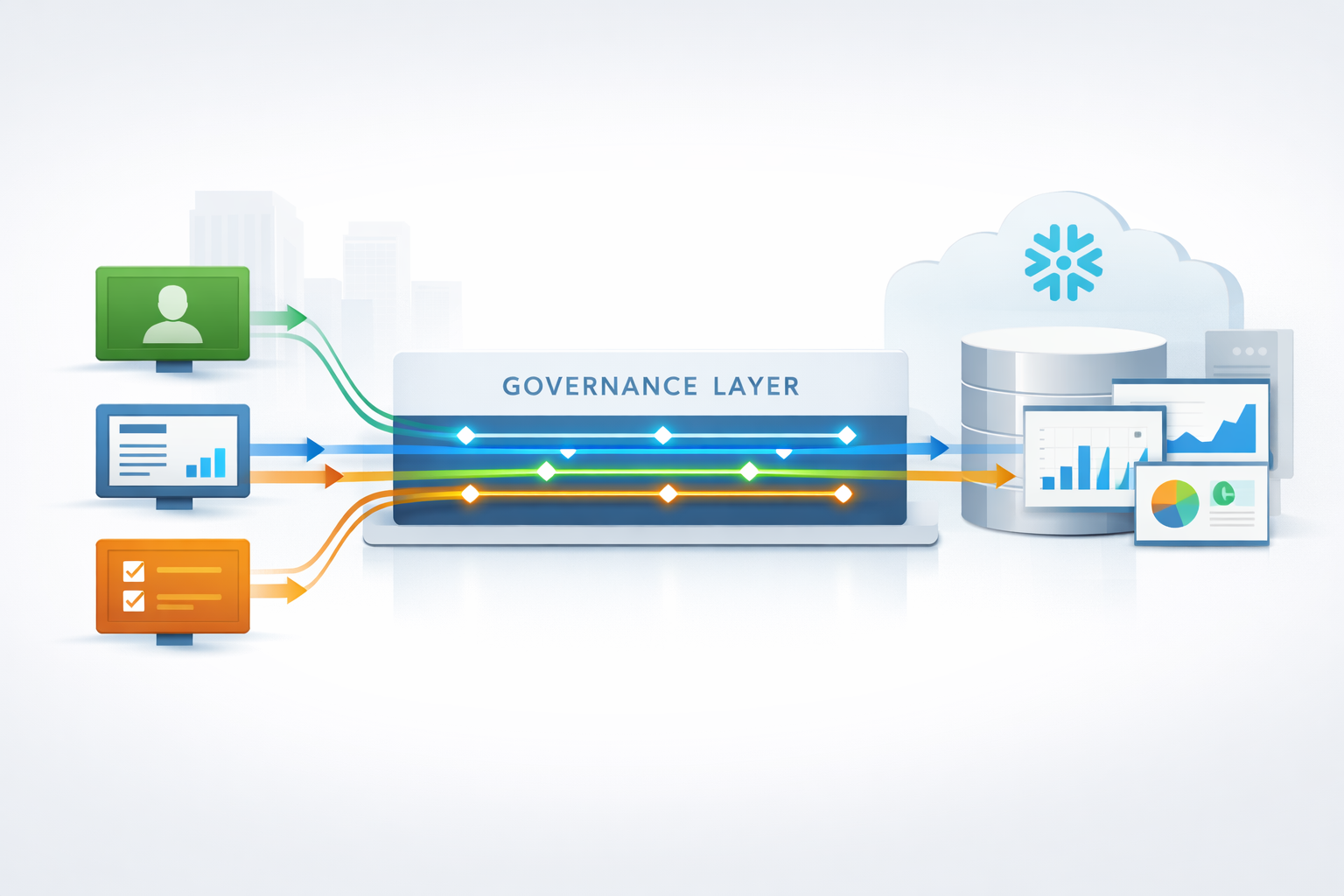
CDHS as the Control Plane for Data in Motion
CDHS, the Centralized Data Hub System, exists to address the gap that becomes visible once those upstream assumptions fail. It does not replace CRM, ERP, or the Snowflake platform. Architecturally, it serves a different role.
CDHS operates as a control plane for enterprise data flow.
Where Snowflake optimizes for data at rest, CDHS governs data in motion. It defines how systems are allowed to interact with one another before outcomes are recorded.
It establishes which system is authoritative at a given moment, under what conditions a state change is valid, and how that change is permitted to propagate across the stack.
Instead of relying on best-effort synchronization and human judgment, CDHS enforces sequencing, dependency awareness, and intentional handoffs between systems. Exceptions are handled deliberately, not retroactively. Conflicts are resolved before they reach downstream analytics.
The result is not more data or more automation. It is more intentional data.
By the time information reaches Snowflake, it already reflects governed decisions rather than accidental system behavior. Snowflake continues to do exactly what it does best, but its output becomes more trustworthy because the architecture upstream is coherent.
CDHS Is Neither CRM nor ERP
Once organizations recognize the need for governance, a common failure pattern appears: they try to elevate an existing system into a role it was never designed to play.
That instinct is understandable. And costly.
ERPs Are Built for Financial Correctness, Not Orchestration
ERPs are optimized for rigor. They enforce compliance, financial accuracy, and operational stability.
That strength becomes a liability when ERPs are pushed upstream to orchestrate go-to-market motion or customer lifecycle decisions. The system enforces correctness, but at the cost of flexibility. Changes become slower. Exceptions become harder to manage. Teams work around the system instead of with it.
CDHS Exists So Systems Don’t Have to Be Re-Purposed
CDHS exists precisely because neither CRMs nor ERPs should be forced to become something they are not.
By externalizing orchestration and governance into a dedicated architectural layer, each system is allowed to operate in its zone of strength. CRMs continue to move revenue efficiently. ERPs remain authoritative for finance and compliance. Data reaches analytics only after it reflects governed, intentional decisions.
CRMs Are Built for Revenue Motion, Not Governance
CRMs are optimized for speed. They are designed to move opportunities forward, support sales workflows, and make pipeline activity visible and actionable.
When CRMs are asked to govern finance, production, or fulfillment logic, they begin to accumulate brittle workflows and hidden dependencies. Rules are layered on top of processes they were never meant to control. Over time, this creates fragility — systems that work until scale or complexity exposes their limits.
The result is not better governance.
It is slower execution and harder-to-diagnose failures.
Snowflake Platform and CDHS Together
Without an upstream governance layer, Snowflake functions primarily as a diagnostic instrument. It shows what happened accurately, comprehensively, and often uncomfortably. Leaders can see discrepancies, lag, and inconsistency, but resolving them still requires interpretation, reconciliation, and follow-up outside the warehouse.
Once CDHS is in place, that role changes.
Because data is governed, sequenced, and validated before it reaches analytics, the Snowflake platform becomes something more than a system of record. It becomes a system leaders can reason from with confidence. Dashboards no longer reflect competing interpretations of reality. Forecasts are grounded in intentional operational decisions rather than retroactive cleanup.
Planning improves because inputs are consistent. Automation and AI initiatives become viable because they are fed data that reflects how the business is meant to operate, not how systems happened to behave. Analytics shift from explaining the past to informing what should happen next.
If You’re Already Running Snowflake
If Snowflake is live and the organization still experiences reconciliation cycles, operational exceptions, and executive debates over which number is correct, the issue is not data warehousing maturity.
It is governance maturity.
CDHS addresses this by formalizing the rules that currently live in people’s heads, Slack threads, and emergency spreadsheets—and enforcing them consistently across systems.
If You’re Evaluating Snowflake
Snowflake is a sound investment. Without an orchestration and governance layer, however, it risks becoming a high-fidelity mirror of systemic dysfunction.
Introducing CDHS alongside Snowflake ensures that scale does not amplify inconsistency, and that analytical growth is matched by operational discipline.
Architecture , Not ToolS
- Snowflake was never designed to decide how your business should operate.
- It was designed to show you the outcome.
- CDHS exists to ensure that outcome is intentional.
- For modern enterprises, this is no longer a question of tools.
- It is a question of architecture.