






















Inside the Kitchen
HubSpot + Zoho CRM Integration
Marketing and Sales Finally Aligned
This use case is about fixing a broken handshake. A company had marketing in HubSpot and sales in Zoho CRM, with a native sync that had stopped working three years ago. Fruition RevOps built a HubSpot Zoho integration through CDHS so deals closed and work began without manual delays.
The Ingredients
Systems & platforms in this HubSpot Zoho CRM integration
HubSpot
Marketing automation, CRM intelligence and contact management
Sales pipeline and opportunity management
Customer health and retention tracking
Centralized Data Hub System (CDHS)
Central data governance and routing


The Mess in the Kitchen
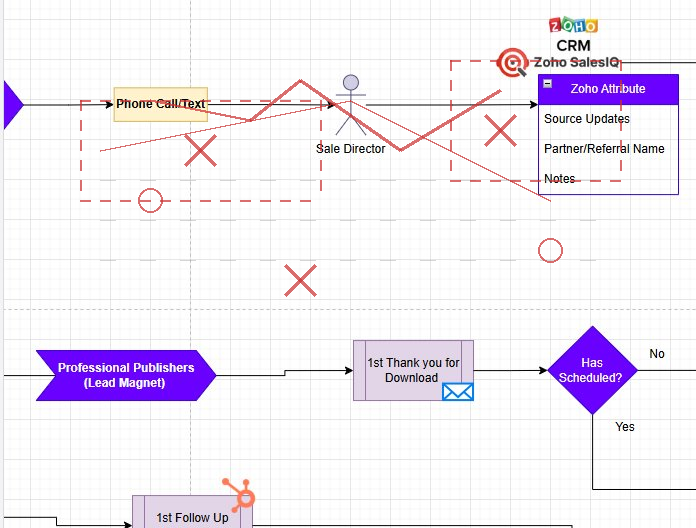
A geospatial analytics company serving major utilities faced a critical gap. Each department ran its own process. When sales closed a deal in HubSpot, finance manually recreated it in Zoho to issue an invoice. When payment cleared, operations had to be told by email to begin production.
That delay between deal close and project start meant hours of wasted time, duplicated effort, and misaligned reporting. The cost of manual handoffs added up fast.
ChurnZero was invisible. Customer data, churn signals, adoption depth—all trapped in ChurnZero. Neither HubSpot nor Zoho saw any of it, leaving post-sale signals buried.
No lead scoring, no lead attribution, no lifecycle governance. Contacts in HubSpot had no stage. Zoho leads had no scoring. Nobody could trace a closed deal back to where it started, breaking full-funnel visibility.
What They Wanted to Serve
A single governed workflow where a closed deal triggers the next phase of work automatically. Finance sees exactly which deals are moving through which stage without asking. The HubSpot Zoho integration needed to eliminate manual handoffs while maintaining governance.
THE HANDSHAKE
Marketing and sales operating in separate systems, but executing as one. Data flows in real time. Leads score automatically. Events trigger action sequences without anyone touching a spreadsheet.
Our Recipe
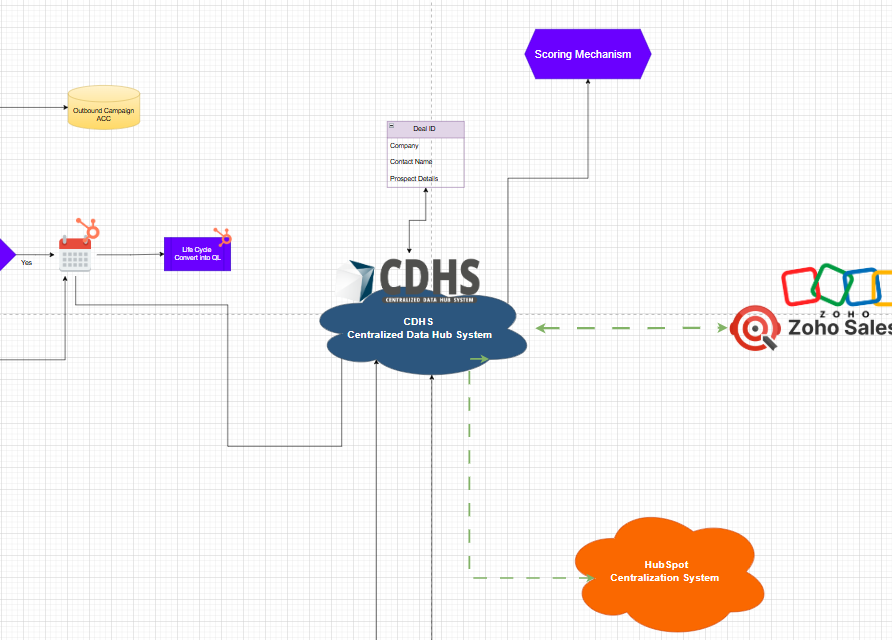
We built a HubSpot Zoho integration where nothing connects directly to anything else. Everything flows through Centralized Data Hub System (CDHS), the centralized governance layer that manages all data flows between systems.
The Architecture of the HubSpot Zoho CRM Integration
CDHS sits at the center. HubSpot becomes the intelligence layer—all contacts, lifecycle stages, scoring, and automation triggers live there. Quick Data Flows (QDFs) handle the orchestration logic. Zoho CRM stays the sales system of record, untouched by any automated process. ChurnZero gets a read layer for the first time, pushing customer health data straight into HubSpot where it fuels lead scoring and lifecycle decisions. Let data flow without manual process—that’s the integration design philosophy.
This freed us to build 35 new properties across five sections of the customer journey: core journey (lifecycle, deal type, attribution), pre-sale engagement (engagement score, intent, content affinity), sales process (demo outcomes, proposal tracking), post-sale (onboarding, churn signals, upsell readiness), and partner journey. The HubSpot Zoho integration now carries all of this governance-rich data in real time.
CDHS Governs Five Core Flows in the HubSpot Zoho Integration
1. HubSpot and Zoho Sync
Rules-based, directional, auditable. Zoho writes deal and pipeline data to HubSpot. HubSpot writes lifecycle stage and lead score back to Zoho. No silent failures—every sync is logged and validated.
2. ChurnZero Read Layer
Pulls health scores, churn risk flags, onboarding status, and adoption depth into HubSpot on a set schedule, making post-sale signals visible to the entire organization.
3. Lead Scoring Engine
Composite score built on engagement signals, event attendance, form fills, and behavioral data. Distributed to Zoho in real time so sales always sees the hottest leads first.
4. QDF Decision Logic
Contact classification, source tagging, ACC enrollment triggers, routing rules all configurable in CDHS without rebuilding automation.
5. Exclusion Protection
Checks every incoming contact against existing Zoho CRM records. Existing customers and active opportunities suppressed from prospect workflows automatically.
The Decision Layer
CDHS doesn’t just govern data flows, it makes decisions. The decision layer is where business logic lives, and it’s where Astera gained a critical advantage: the ability to change routing rules without rebuilding automation.
In the case of this client, every lead that enters either QDF triggers a classification decision in CDHS. Is this contact a net-new prospect? An existing customer? A churned account? A partner channel lead? Based on that classification—plus geography, product type, and opportunity size—CDHS automatically routes the contact to the right sales team, rep, or nurture flow.
The key difference is that those routing rules are configurable from a dashboard. When Astera’s territory assignments changed mid-quarter, or when they wanted to test a new lead distribution model, they didn’t need Fruition to rebuild workflows. They updated the rules in CDHS, and the system adapted in real time. No development cycle. No deployment window. No manual reassignment of thousands of contacts.
This same decision-layer pattern applies to their secondary use case: the Excel lead import flow. Hundreds of leads imported weekly from GovWin and intent data platforms get scored and routed by the same configurable logic. Sales sees high-fit prospects immediately. The rules adjust as the market shifts. The system scales without architectural changes.
The Two QDFs Powering the HubSpot Zoho Integration
Quick Data Flow #1
Exhibition, Events & Webinars
Target: Live before the exhibition. This QDF owns event intake and transforms raw registrant lists into governed, scored contacts ready for sales.
- Registrant capture from Zoho Webinar, third-party platforms, badge scanner exports
- Contact classification on entry: existing customer, active prospect, net-new, churned, partner
- Automated contact creation and QDF enrollment triggered by classification and source
- Post-event sequences managed automatically via HubSpot workflows
- Qualified net-new contacts synced to Zoho as governed leads with proper attribution
- Attendance signals fed back into the scoring engine for real-time lead ranking
Quick Data Flow #2
Content Lead Magnets
Target: After QDF #1 production launch. This QDF owns inbound lead intake from multiple sources, deduplicates, and routes to sales or nurture based on fit.
- Unified intake from three sources: intent data, educational content lists, CSV imports
- Deduplication and ICP-fit checks on entry prevent duplicate records
- CDHS exclusion check protects existing customers and active opportunities from re-prospecting
- Automated TALK-to-TASKS enrollment based on source and lifecycle stage
- Lead scoring applied on intake; high-fit contacts flagged for Zoho visibility with urgency signals
- Attribution tag applied at entry for full-funnel pipeline reporting and ROI analysis
How It's Served
The build followed a parallel track. Setup and both QDFs started simultaneously, compressing timeline without sacrificing governance or testing.
Foundation
CDHS environment, 35 properties, lifecycle architecture, HubSpot and Zoho sync, ChurnZero read layer, scoring foundation
Weeks 1–2
QDF #1 Build
Events & Webinars flow, badge scan integration, ACC triggers, Zoho sync logic
Weeks 2–5 (parallel)
QDF #2 Build
Content Lead Magnets intake, deduplication logic, ACC enrollment, scoring rules
Weeks 2–5 (parallel)
QDF #1 Live
Exhibition go-live—end-to-end test, production validation, live event data flowing
Week 6–7
QDF #2 Live
Content Lead Magnets production launch, scoring engine live across all inbound sources
Week 7–8
Stabilize
Post-launch tuning, both QDFs, scoring calibration based on live performance data
Weeks 8–9
The Constraints That Mattered
Zoho stayed read-only. CDHS writes only for lifecycle stage updates and governed lead creation from qualified events. No Sales workflows, fields, or processes were touched. Both QDFs started on day one with no sequential dependency. Every incoming contact was checked against the Zoho CRM exclusion list before entering any marketing workflow. Lead scoring was co-defined with the client before any properties went live. The entire HubSpot Zoho integration was designed to preserve existing Zoho workflows while adding governance at the sync layer.
The Review
❌ Before
Manual event processing every week—hours of spreadsheet work per exhibition
Teams relied on email threads to keep sales aligned with operations
No lead scoring. No way to prioritize which prospects mattered
Silent sync failures appeared randomly across systems
Duplicate entries between HubSpot and Zoho with no single source of truth
Customer health data locked in ChurnZero, invisible to everyone
✓ After
Events flow directly into HubSpot. Scoring and routing happen automatically
60% reduction in internal emails between departments
40% faster project initiation from deal close to first build
Zero duplicate entries between HubSpot and Zoho
One centralized data management system ensuring accuracy and governance
Customer health signals surface in real time to both marketing and sales
Ready to Cook Up Your Own Integration?
Stop letting Zoho and HubSpot work against each other. We’ve got the recipe to fix it—and we’re ready to share.