






















Centralized Data Flow, One Truth
Data Centralization
CDHS doesn’t replace your CRM or ERP — it governs them.
One hub orchestrating every data flow, every department, every result.
Centralization for Survival
Automation stops leaks. It smooths handoffs. But without centralization, every department still runs its own version of the truth. Sales says revenue is up. Finance shows another number. Ops points to fulfillment gaps. In the boardroom, the debate isn’t about growth. It’s about whose spreadsheet is right.
Centralization changes everything. A Single Source of Truth (SSOT) removes the guesswork. Instead of siloed dashboards, every department works from the same real-time data. Leaders gain clarity, teams gain confidence, and growth becomes predictable because decisions are based on facts, not assumptions.
Centralization Is Not About Replacing Systems — It’s About Governing Them
Centralize Your Data | Accuracy and Efficiency
Connect CRM, ERP, Finance, and Operations into a single hub.
Eliminate reporting errors, stop silos, and make faster, data-driven decisions.
Not All Alignment Is the Same
Companies chase data alignment in three ways: point-to-point automations, Customer Data Platforms, or true centralization through CDHsystem. Two create more silos. Only one creates a Single Source of Truth.
Automations
CDP
CDHS
Centralization Fails Without a Blueprint
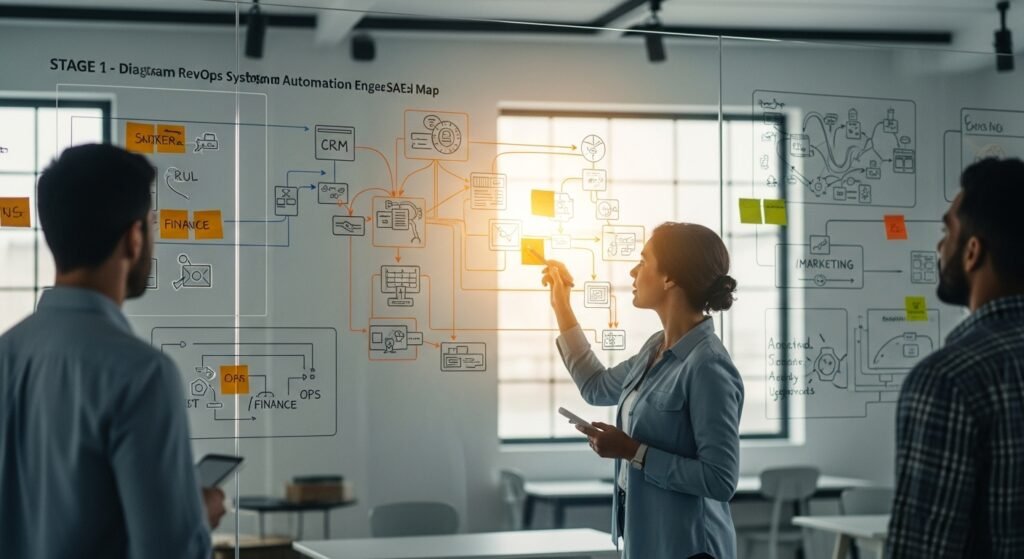
The Foundation of Flow - Building the Data Centralization Framework
Before we connect anything, Fruition RevOps builds a System Automation Engagement (SAE) Map, revealing every data route, dependency, and interaction between your teams and systems. From that blueprint, we design the CDHS layer — the logic that controls the flow, ownership, and synchronization between your platforms.
Each workflow, whether part of a marketing Automation Campaign Creator (ACC) or an internal operations automation, runs through the CDHS. The system ensures that data from CRM, ERP, Logistics, or Project Management aligns with your company’s Standard Operating Procedures (SOPs).
Proof in Centralization Looks Like
A shipment goes out in Shipwell. Without centralization, Ops sees it, but Sales stays blind, Finance reconciles late, and Customer Success finds out only when the client calls. With centralization, one update flows through Monday, Finance, and Intercom instantly. Every team sees it. The client feels cared for, not left waiting.
Forecasting tells the same story. Sales logs the deal, Finance books revenue, Ops schedules delivery. Without centralization, every system shows different numbers and leadership wastes a week arguing. With CDHsystem, everything reconciles in real time. The boardroom walks in aligned, confident, and focused on strategy.
Once the CDHS is in place, every new automation, integration, or workflow can be added without chaos.
Production release SOP, so the system checks design approvals, validates compliance docs, and only then starts production across Katana, CIN7, and Shipwell.
Delivery feedback loop, so if a shipment is closed but feedback is negative, the system reopens the case, alerts quality control, and pauses invoicing until resolved.
High-value deal approvals, so any deal above $250K automatically routes through multi-tier approvals, locks pricing, and syncs signed orders into finance.
Engineering change process, so when a new product version is released, inventory, procurement, and sales automatically update to reflect new specs and stock status.
Revenue recognition SOP, so Finance only posts revenue once delivery confirmations and project tasks are fully completed.
Client routing SOP, so each new deal follows a different operational flow based on industry, contract type, or region.
Post-sales warranty SOP, so every installation starts a maintenance schedule and triggers automatic renewal reminders.
Made-to-order SOP, so every approved deal instantly generates a full product specification and new SKU record
Engineering-to-production SOP, so approved drawings, revisions, and materials flow automatically into manufacturing boards.
Component tracking SOP, so serial numbers, parts, and assemblies stay linked through every production stage.
Quality release SOP, so inspection data, test results, and compliance certificates are validated before shipment.
Shipment-to-support SOP, so once delivery is confirmed, onboarding, warranty, and maintenance workflows activate automatically.
Project-to-support handoff SOP, so production data, assets, and serial numbers automatically create the support onboarding record, assign the CSM, and activate warranty & maintenance workflows.
Scale Without Rebuilding
The CDHS as Your Long-Term Data Architecture
That’s because the foundation isn’t a tangle of point-to-point connections — it’s a governed environment where each system plugs into a pre-defined structure.
Think of it as building a smart city for your data. The bridges and roads (APIs, automations, data flows) already exist, and every department’s SOP defines its checkpoints. When your business adds a new platform, workflow, or integration, you’re not building from scratch — you’re simply adding a new address to an existing map.
This is what makes CDHS so powerful: it doesn’t demand an overhaul, only alignment.
Your CRM still runs your pipeline. Your ERP still manages finance. But the CDHS manages the relationships between them, ensuring that when automation triggers, data moves in sequence and every report — whether from Marketing, Operations, or Finance — reflects the same reality.
This is why the CDHS can’t be built as a one-time IT project. It must be designed around your company’s real workflows, decision points, and engagement methods — by experts who understand both the data logic and the revenue logic of your organization. Fruition RevOps specializes in that intersection: the place where your data, your teams, and your revenue meet.
The Power of One Truth
Centralization isn’t about more dashboards. It’s about trust. It’s the difference between leadership second-guessing reports and leadership making real-time decisions. Between Ops chasing updates and Ops delivering every time. Between teams running parallel and teams moving as one.
Not every company chooses centralization. But those who do never go back. “Once you’ve run a business on one flow and one truth, anything less feels like chaos.”